
An unexpected email offering a partnership with a globally recognized brand can look like an exciting business opportunity. For a web design agency, WordPress developer, or digital marketing freelancer, a message from a major company may represent the possibility of a valuable client relationship and long-term business growth.
However, not every professional-looking inquiry is what it appears to be.
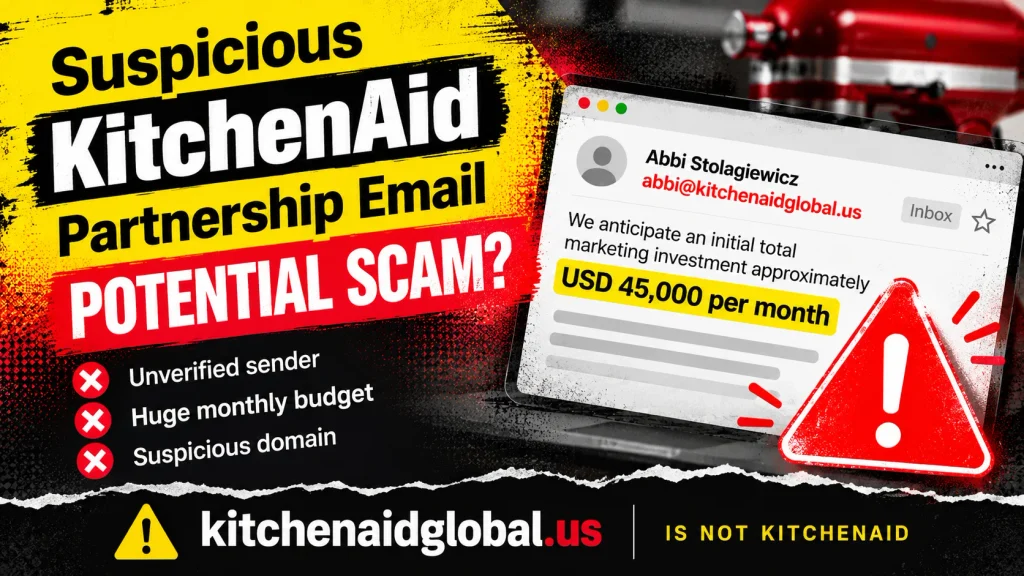
WPF Creatives recently received a contact-form submission from someone claiming to represent KitchenAid. The message proposed a digital marketing partnership involving creative services and ecommerce growth, with an anticipated initial marketing investment of approximately $45,000 per month.
Although the inquiry included links to KitchenAid’s social media profiles and described a potential collaboration, the sender’s identity and authorization were not established by the submission itself.
This experience highlights an important lesson for digital agencies: a recognizable brand name, professional language, and an attractive budget do not prove that a business inquiry is legitimate.
In this guide, we’ll examine the details of the submission received by WPF Creatives, explain the warning signs, and share practical steps agencies can take to verify similar opportunities safely.
What Did the WPF Creatives Contact Form Reveal?
On October 16, 2026, WPF Creatives received an inquiry through its website contact form. The sender identified themselves as Abbi Stolagiewicz and provided the email address abbi@kitchenaidglobal.us.
The inquiry was categorized under digital marketing and described a potential partnership supposedly involving KitchenAid, a well-known kitchen appliance brand.
The message stated that the company was exploring partnerships with selected agencies to support digital marketing and ecommerce growth. It also mentioned creative work, consumer engagement, and opportunities to increase product sales.
The sender proposed an initial marketing investment of approximately $45,000 per month. However, the message indicated that the specific scope would be developed collaboratively at a later stage.
It concluded by inviting WPF Creatives to express interest through the supplied email address, promising to share further information about the proposed partnership.
Several details deserved closer examination:
- Unverified business identity: The submission did not independently confirm that the sender worked for KitchenAid or was authorized to represent the company.
- An unfamiliar email domain: The sender used
kitchenaidglobal.us, rather than KitchenAid’s familiar primary domain,kitchenaid.com. This difference warrants verification but does not, on its own, establish fraudulent activity. - A substantial proposed budget: The message mentioned approximately $45,000 per month without providing a detailed scope, deliverables, timeline, or approval process.
- Generic partnership language: The wording referred to agency strengths, local market knowledge, and long-term collaboration without identifying specific WPF Creatives projects or explaining why the agency had been selected.
- Social media references: Links to KitchenAid’s Instagram and Facebook profiles were included, but those links did not verify the sender’s identity.
- A request to continue by email: The sender asked the agency to reply to the submitted address before providing further partnership details.
Individually, these details do not prove that the inquiry was fraudulent. Taken together, however, they provide reasonable grounds to pause and independently verify the opportunity before proceeding.
For privacy, the sender’s full phone number and other unnecessary personal details are omitted from this article.
Name: Abbi Stolagiewicz
Email: abbi@kitchenaidglobal.us
Phone Number: 2027981667
What services are you interested in?: Digital Marketing
Send us a message or ask a question: Hi,
I’m reaching out from KitchenAid as we’re exploring partnerships with a select group of agencies to support digital and ecommerce growth in the markets you serve.
KitchenAid is a global kitchen appliance brand that inspires creativity in cooking and baking.
More about KitchenAid:
https://www.instagram.com/kitchenaidusa/
https://www.facebook.com/KitchenAid/
Based on our initial review, we see a potential fit between your agency’s strengths, local market knowledge, and the opportunities we’re exploring.
Our focus is on helping consumers discover, engage with, and purchase KitchenAid’s appliances, attachments, and accessories. We’d welcome a collaborative partner who can help shape the strategy and contribute through their strongest capabilities, whether in creative work, digital marketing, or ecommerce.
The initial scope would be developed together, giving your team an opportunity to influence the approach from the outset and build toward a broader, long-term partnership.
We anticipate an initial total marketing investment of approximately USD 45,000 per month, with scope to increase as your team demonstrates value and further growth opportunities emerge.
If this interests your team, please reply to the email address provided in this form. A brief expression of interest is enough at this stage—I’ll share our priorities and partnership overview, with no formal proposal required.
Kind regards
Why the Email Domain Deserves Attention
One of the first things to examine in an unexpected business inquiry is the sender’s complete email address.
An email address may contain a recognizable company name without being controlled by that company. For example, kitchenaidglobal.us and kitchenaid.com are different domains. The presence of the word “KitchenAid” in an address does not establish an official relationship.
This is an important principle when investigating potential brand impersonation. A sender’s display name, email signature, and claimed job title can all appear convincing without independently establishing who is behind the message.
When an inquiry claims to represent a major brand, agencies should verify whether the sender’s domain is associated with the organization and whether the person is authorized to discuss the proposed work.
The safest approach is to navigate independently to the company’s official website and use its published contact channels. Avoid relying exclusively on links, phone numbers, or verification instructions supplied in the suspicious message.
A different email domain is a warning sign to investigate, not conclusive proof of a scam. Some legitimate organizations use separate domains for regional operations, marketing campaigns, or authorized service providers. The key is independent confirmation.
Why a Large Marketing Budget Is Not Proof of Legitimacy
A proposed investment of $45,000 per month is naturally attractive to a marketing agency or freelance professional.
For a growing business, an opportunity of this size could represent substantial revenue, a long-term relationship, and an opportunity to demonstrate expertise to a major brand.
However, the financial value of an offer should never replace normal client verification.
Legitimate companies sometimes approach agencies with large budgets before finalizing a complete project scope. Therefore, a high budget alone does not establish fraudulent intent.
Concern becomes more reasonable when a substantial offer is combined with an unverified sender, limited project-specific information, and an unclear business relationship.
Before committing time or resources, an agency should establish:
- The client’s identity and authority to commission the work.
- The project’s business objectives and expected deliverables.
- The campaign timeline and approval process.
- The identity of the person responsible for making decisions.
- The commercial terms and payment arrangements.
- The official channels through which documents, contracts, and account access will be managed.
A genuine opportunity should withstand reasonable questions about identity, scope, and process.
The practical rule is simple: evaluate the opportunity only after you have taken reasonable steps to verify who is offering it.
Why Official Social Media Links Can Be Misleading
The message received by WPF Creatives included links to KitchenAid’s Instagram and Facebook profiles.
At first glance, these references can make a message appear credible. A recipient recognizes the brand, sees familiar product imagery, and may assume that the person contacting them is connected to the company.
However, anyone can copy and paste links to public social media profiles into an email or contact form.
A genuine company profile does not authenticate the sender, confirm their employment, or establish that the company approved the proposed partnership.
The same principle applies to company logos, branded email signatures, professional formatting, and product photographs. These elements can be copied and used in misleading communications.
Instead of relying on branding as proof, verify the sender independently. Navigate to the company’s official website, locate its published contact information, and ask whether the proposed partnership or representative can be confirmed.
How a Fake Partnership Inquiry Could Become a Phishing Attempt
An unverified business inquiry does not automatically mean that a phishing attempt has occurred. Nevertheless, agencies should understand how a fraudulent approach could develop.
One possible scenario begins with an attractive partnership proposal. After the recipient expresses interest, the sender may offer to provide a campaign brief, partnership presentation, contract, or other supporting documents.
In a malicious scenario, the follow-up could contain a link to a fake sign-in page, an unfamiliar document-sharing portal, or an unexpected attachment. Such content could attempt to obtain account credentials or expose the recipient to malicious software.
These are examples of general phishing techniques, not events confirmed in the WPF Creatives case. The original contact-form submission alone does not establish that the sender distributed malware or attempted to steal information.
Agencies should therefore avoid assuming the worst while still following sensible precautions.
Do not enter account credentials through unsolicited links. Be cautious with unexpected attachments, verify document-sharing requests, and use established business channels to exchange sensitive information.
If the sender asks you to log in to view a proposal, verify the request independently before proceeding.
How to Verify a Brand Partnership Inquiry Safely
A consistent verification process helps agencies distinguish credible opportunities from suspicious approaches without automatically dismissing legitimate business.
Step 1: Examine the complete email address
Check the domain after the @ symbol rather than relying on the sender’s display name.
Look for unexpected domain variations, unfamiliar extensions, additional words, or domains that resemble a known brand. Remember that these differences are reasons to investigate, not definitive proof of fraud.
Step 2: Verify the company independently
Navigate to the company’s official website yourself. Locate its published contact details and ask whether the partnership, representative, or marketing initiative can be confirmed.
Do not use only the phone number or link provided in the original inquiry.
Step 3: Ask for specific business details
Request a clear explanation of the proposed work, objectives, deliverables, timeline, decision-makers, and commercial arrangements.
These details help you assess whether the opportunity fits your services and whether the proposed engagement follows a credible business process.
Step 4: Verify the representative’s role
Check the person’s professional identity through reliable, independently located sources. Where appropriate, ask the company to confirm that the person is authorized to discuss the partnership.
A professional profile or business signature can be useful supporting information, but neither should be treated as definitive proof on its own.
Step 5: Check links and attachments carefully
Before visiting a website, inspect its actual destination and domain. Do not assume that a link is safe because its visible text names a familiar company.
Avoid opening unexpected files until their legitimacy has been established. If a document requires you to sign in, navigate to the relevant service independently instead of following an unsolicited login link.
Step 6: Protect business accounts
Enable multifactor authentication on important accounts, use unique passwords, and keep your devices and software updated.
These measures reduce the potential impact of credential theft and other account-security incidents, even when a suspicious message reaches your inbox.
Step 7: Keep a record of suspicious inquiries
Preserve relevant messages, submission records, and email headers where available. These records may help you verify the sender, report suspected impersonation, or investigate an incident later.
What to Do If You Receive a Similar Message
If your agency receives an unexpected partnership offer from a major brand, pause before responding or accepting any proposed next steps.
First, preserve the original message and avoid clicking suspicious links or opening unexpected attachments. Next, verify the sender through an independent official channel.
If the inquiry cannot be verified, you can decline to proceed, report it to the relevant email provider, or contact the impersonated company through its official reporting channel.
If you have already entered credentials on a suspicious page, change the affected password through the official service, review active sessions, revoke anything suspicious where possible, and confirm that multifactor authentication remains secure.
If you downloaded or opened a suspicious file, follow your organization’s device-security procedures and seek appropriate technical assistance if necessary.
If financial information or business accounts may have been compromised, contact the relevant service provider promptly and follow its incident-response guidance.
The important point is to respond proportionately to what actually happened. An unverified inquiry warrants caution; evidence of a compromised account requires additional security steps.
How Website Owners Can Reduce Suspicious Contact Form Submissions
The WPF Creatives experience also highlights an important consideration for website administrators: a contact form is a public entry point, and it can receive misleading or unwanted submissions.
A form that successfully delivers a message has not necessarily established the sender’s identity. Even a professionally designed website can receive deceptive inquiries.
Website owners can reduce risk by implementing several practical safeguards.
Use server-side validation
Validate submitted data on the server instead of relying only on browser-side checks. This helps protect the form against malformed input and some types of automated abuse.
Implement appropriate spam protection
Use reputable anti-spam measures, rate limiting, and other controls appropriate to your website. These can reduce unwanted submissions, although no single technique will eliminate every suspicious inquiry.
Monitor submission patterns
Watch for repeated messages, unusual submission bursts, and other suspicious patterns. Treat technical indicators as supporting evidence rather than proof that a specific person is malicious.
Apply privacy-conscious logging
Retain only the information necessary for legitimate security and operational purposes. Restrict access to submission records and apply appropriate retention policies.
Keep website software updated
Maintain your CMS, plugins, themes, and server software. Review security settings regularly and ensure that website administrators use strong authentication.
Establish a verification procedure
Make sure staff members know how to handle unusual partnership requests. Before opening documents, sharing confidential information, or granting account access, confirm that the business relationship is credible.
For WordPress websites, these measures can complement existing contact-form and security plugins. No plugin can independently guarantee that every sender is legitimate.
Frequently Asked Questions
How can I recognize a fake KitchenAid partnership email?
Examine the complete sender address, verify the person’s claimed affiliation through an independent official channel, and assess whether the proposal includes credible business details. Familiar branding, social media links, and an attractive budget are not proof of authenticity.
Is an email legitimate if it includes official KitchenAid social media links?
Not necessarily. Public social media links can be copied into any message. Verify the sender separately through KitchenAid’s official website or another independently confirmed contact channel.
Should an agency trust an offer of $45,000 per month?
The budget alone should not determine whether an offer is genuine. Verify the client’s identity, confirm the business relationship, and establish the scope and commercial terms before committing resources.
What should I do if I clicked a suspicious partnership link?
If you only opened a page, close it and avoid entering information or downloading files. If you submitted credentials, change the affected password through the official service and review account security. If you downloaded or opened a suspicious file, follow appropriate device-security procedures.
Can contact-form spam protection stop every fake inquiry?
No. Spam filtering, rate limiting, and server-side validation can reduce unwanted submissions, but they cannot independently establish the identity or intentions of every person who submits a form.
Where can I check KitchenAid’s official information?
Start with KitchenAid’s Authentic KitchenAid Product guidance and its official customer service page. Use an appropriate official channel to ask about a suspected business impersonation.
Conclusion: Verify the Opportunity Before You Accept It
The contact-form submission received by WPF Creatives is a useful reminder that professional-looking business inquiries still require due diligence.
The message claimed a KitchenAid affiliation, proposed a substantial monthly marketing investment, and included familiar brand references. However, the sender’s identity and authorization were not established by the submission itself.
That distinction matters. Agencies should investigate suspicious details without making unsupported accusations, and they should verify business opportunities before responding to requests involving accounts, documents, or sensitive information.
The takeaway is simple: verify the sender, confirm the business relationship, and protect your accounts before proceeding with an unexpected partnership offer.
At WPF Creatives, we believe that building a reliable digital presence includes taking website security and business communications seriously. Whether you manage a WordPress website, run a digital marketing agency, or work independently, a consistent verification process can help you make better-informed decisions about incoming business inquiries.
If your business needs help with website development, WordPress maintenance, or improving the reliability of its online presence, explore the services offered by WPF Creatives.