
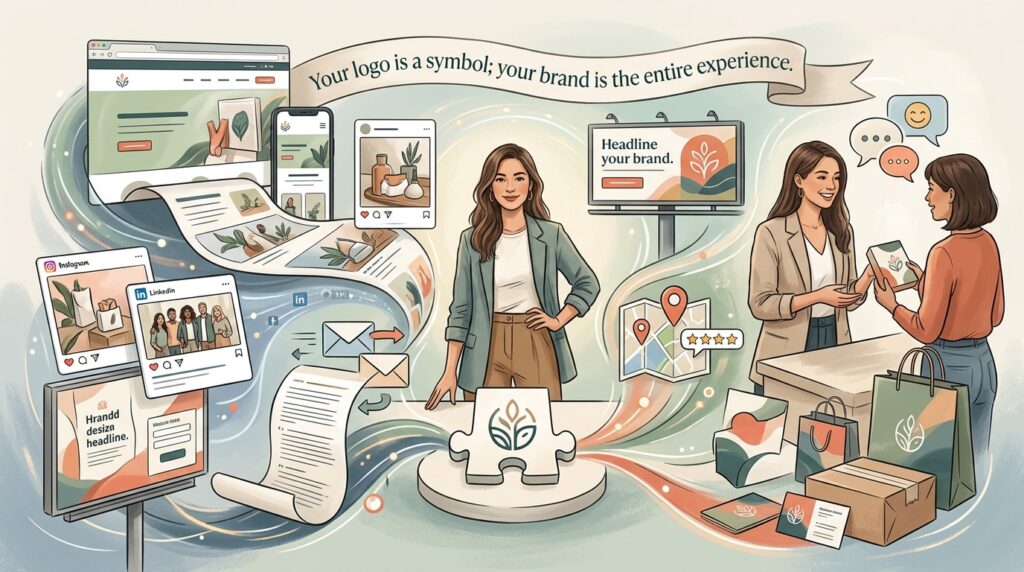
Your logo is not your brand. It never was.
That one sentence trips up more business owners than almost anything else in marketing, and it’s exactly why we’re starting this Brand Identity 101 guide right here. If you’ve spent months tweaking colors and fonts hoping customers will finally “get” you, this is for you.
A logo is a symbol. A brand identity is everything a person feels, remembers, and trusts about you before, during, and after they buy. Big difference. And once you understand that difference, your entire approach to marketing changes for the better.
WHO This Guide Is For
This isn’t written for design students. It’s written for the people actually running businesses.
- Small business owners who just paid for a logo and are wondering why sales haven’t moved
- Larger business owners scaling into new markets who need consistency across teams
- Law firms and professional service providers who rely on trust more than flashy visuals
- Anyone comparing digital marketing services and unsure what they’re actually paying for
If any of that sounds like you, you’re going to walk away from this with a clearer head and a real plan, not just another design brief.
WHAT the Real Problem Actually Is
Here’s the honest truth. Most businesses confuse “having a logo” with “having a brand.” They’re not the same thing, and treating them as identical wastes money and momentum.
Brand identity is the full experience: your tone of voice, your website feel, your customer service, your consistency across every touchpoint. A logo is just one visual piece of that puzzle.
| Logo | Brand Identity |
|---|---|
| A symbol or mark | The full customer experience |
| Static, rarely changes | Lives in every interaction |
| Designed once | Built and reinforced continuously |
| Can be copied | Built on trust, hard to replicate |
When a business skips straight to logo design without defining voice, values, and positioning, the marketing built on top of it (ads, content, SEO) has nothing solid to stand on. That’s the opportunity hiding inside this problem. Fix the foundation, and everything you build afterward performs better.
WHY This Matters Right Now
Competition online has never been this loud. Every industry, from roofing to law firms to boutique retail, is fighting for the same few seconds of attention.
Here’s why waiting on this is risky:
- Customers decide whether to trust you in under 10 seconds of landing on your page
- Inconsistent branding across social media, your website, and ads quietly erodes trust
- Businesses with a clear identity convert better because people buy from brands they recognize, not just logos they saw once
- If your competitor nails their branding strategies before you do, they win the customer’s memory first, and memory is very hard to undo
This isn’t about vanity. It’s about survival in a market where attention is the scarcest resource you have.
HOW to Build a Brand Identity That Actually Works
This is where we get practical. No fluff, just a real sequence you can follow.
Step 1: Set Your Branding Strategy Before You Touch Design

Before any visuals, write down your voice, your values, and the one problem you solve better than anyone else. This is the backbone of solid branding strategies, and skipping it is the number one reason rebrands fail.
Ask yourself:
- What do I want people to feel after one interaction with my business?
- What three words should describe my brand tone?
- Who am I definitely not trying to attract?
Step 2: Build Content That Reflects That Identity
Once your voice is clear, your content marketing strategy needs to carry it everywhere. This means applying real content writing tips and blog writing tips so every piece sounds like you, not like a generic template.
Good SEO content writing does two jobs at once. It ranks, and it reflects your identity. Blogging for business works best when each post answers a real question your audience is already searching for, in your actual voice.
Step 3: Get Your On-Page SEO Right
A strong identity means nothing if nobody finds you. This is where SEO best practices and search engine optimization techniques come in.
Focus on:
- Clean on-page SEO: title tags, headers, and internal links that match search intent
- Running a proper SEO audit checklist every quarter to catch broken links and slow pages
- Using solid keyword research tools to find what your actual customers type into Google
- Applying SEO tips for small business owners specifically, since your budget and priorities differ from enterprise brands
- General small business SEO hygiene: mobile speed, secure hosting, and clear navigation
Step 4: Own Your Local Presence
If you serve a physical area, this step is non-negotiable. Local SEO services and Google My Business optimization put your brand identity in front of people who are ready to buy nearby.
This applies even to service-heavy industries. Law firm marketing strategies and legal marketing tips increasingly rely on local search visibility, since most people search “near me” before they call anyone. Pair that with consistent local business marketing across directories, and you build recognition fast.
Step 5: Show Up Consistently Across Channels
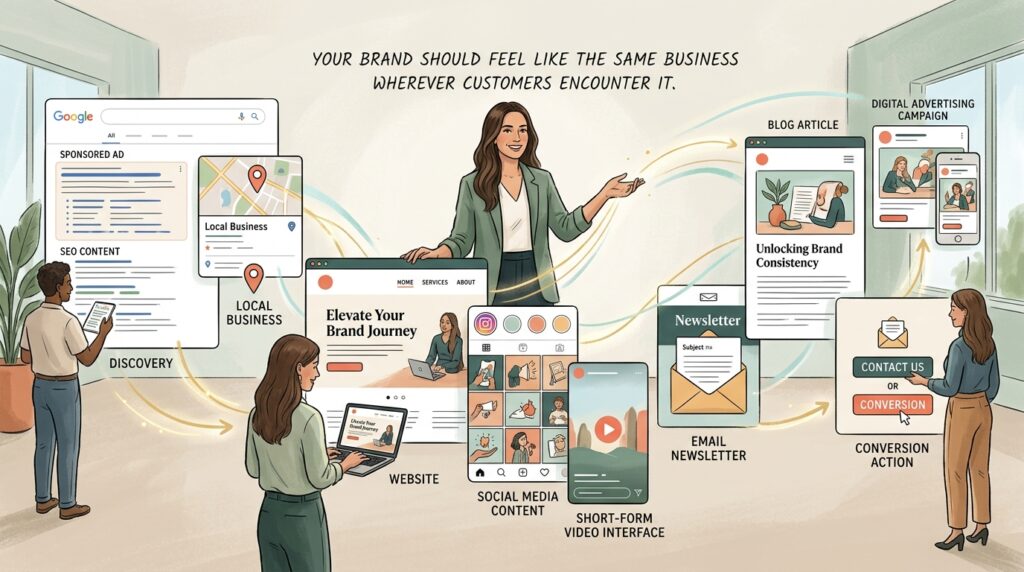
Your identity needs to feel the same whether someone finds you on Instagram or in their inbox.
- Apply social media marketing tips and broader social media marketing strategies so your tone stays consistent post to post
- Use Facebook advertising tips to target the right audience without diluting your message
- Add a video marketing strategy, even short clips, since video builds trust faster than static posts
- Keep an email marketing strategy running with real email marketing tips, like segmenting your list so messages feel personal, not blasted
Step 6: Turn Recognition Into Revenue
Visibility without conversion is just noise. This last step connects branding to actual growth.
- Use a pay-per-click advertising strategy to put your identity in front of ready-to-buy searchers
- Run Google Ads marketing campaigns that match your brand voice in the copy itself
- Build real lead generation strategies around your content, not just your ads
- Apply conversion rate optimization to your landing pages so the traffic you already have converts better
- Tie it all together with one clear online marketing plan, so every channel supports the same identity instead of working in isolation
These are the kind of digital marketing tips that compound over time, rather than fixing one channel while ignoring the rest.
Common Questions About Brand Identity
Is a logo part of brand identity? Yes, but only a small part. It’s the visual entry point, not the full experience.
How long does it take to build a strong brand identity? Most businesses see real recognition build over 6 to 12 months of consistent effort across content, SEO, and social channels.
Do small businesses really need a brand strategy, or just a logo? A strategy first, always. A logo without strategy is just decoration.
Key Takeaways
- Your logo is one visual piece, not the whole brand
- Brand identity lives in your content, your SEO, your ads, and your customer service
- Consistency across every channel builds the trust that actually drives sales
- Local visibility and on-page SEO give your identity somewhere to be found
- A connected online marketing plan beats scattered, one-off campaigns every time
Final Thoughts
Brand Identity 101 really comes down to one shift in thinking: stop treating your logo like it’s doing all the work. It isn’t, and it never will. Your identity is built in the small, consistent details, your website copy, your social tone, your local listings, your follow-up emails, all pointing in the same direction.
If you’ve been pouring budget into design without a strategy underneath it, this is your sign to pause and fix the foundation first. The businesses that get this right don’t just look good. They get remembered, and remembered is what actually gets people to buy.
If you’re ready to build a brand identity that does more than sit pretty on a business card, start with your strategy, then let your content, SEO, and local presence carry it everywhere your customers already are.