
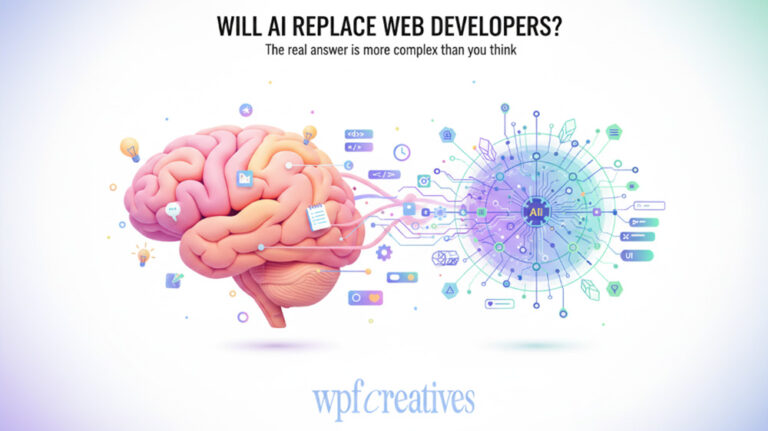
The Real Answer Nobody's Talking About
If you’ve recently Googled “will AI replace web developers” you’re not alone and you’re asking the right question.
The headlines are loud. The fear is real. And the confusion? Overwhelming.
But here’s something most articles don’t explain: the answer is no, and also yes, it’s bit more complex and you will have developed it, a digital marketer or simply someone who wants to work in technology in 2026, it will be the most informative post you read today. Let’s cut to the chase.
WHO Is This For and Who Should Be Paying Attention Right Now?
There are three types of people reading scared headlines:
First, there are the developers front end, back end, full stack who are seeing the tools they use improve every three months and wondering if their skills will be needed in the future. If you’ve ever asked yourself “will AI replace front end developers before I get my next pay raise?” then this article is for you.
Second, there’s the digital marketers and entrepreneurs that use web development to build their brands. They’re wondering: can they get their websites built by AI for $1000? Or is that wishful thinking?
Third, Third are the career changers, those who are on the fence this year, and ask the question of themselves, should I learn to code in 2026, or will I be placing my head in the chopping block?
Each of these groups need an answer. Here it comes.
WHAT Is Happening: Describing the Problem
Let’s get straight to the facts of the matter.
The question “will AI take over the jobs of web developers?” is really a series of questions:
- Can AI produce code? Yes.
- Will AI design and build a site? Partially.
- Can AI do the thinking, creativity and problem-solving that a developer does? Not even close.
GitHub Copilot, Cursor, and a range of no-code AI development platforms are revolutionising the way we code. AI-powered automation in software development is no longer futuristic it’s day-to-day. Developers are automating boilerplate, debugging code, creating component drafts and even prototyping new ideas in hours rather than days.
But here’s what the tools don’t do.
They can’t sit in a discovery call with a client and understand that what the client says they want and what they actually need are two completely different things. They can’t read the room. They can’t make the call on a design decision that needs to weigh business goals, user psychology, brand identity, and technical debt all at once.
AI builds what you describe. Humans understand what you mean.
That gap? That’s the entire future of web development in 2026 and beyond.
WHY This Matters Right Now: The Stakes Have Never Been Higher
Here’s the uncomfortable truth about the future of coding jobs: the pressure is not coming from AI replacing developers. It’s coming from developers who use AI replacing developers who don’t.
That shift is already happening.
A developer who can use AI tools to do the work of three people at the speed of one is not a threat to the industry they are the industry, right now, in 2026. Clients feel this. Agencies feel this. Hiring managers feel this.
The fear of missing out here isn’t abstract. If you’re a developer still writing every line of code manually with no AI integration in your process, you’re burning time that your competition isn’t. If you’re a marketer who thinks AI will be able to replace your development team, you might soon learn what it’s like when your client’s custom WooCommerce store breaks at 2am and there’s no one who knows the code lying around.
Any extreme is hazardous.
The sense of urgency in this case is not that AI is going to eliminate developer jobs in large numbers but because the position is changing rapidly. And technologically quick is to wink, and 6 months non-activity leaves a skills gulf a year to bridge.
The Limitations of AI in Programming: What the Hype Misses
However, first, before we discuss solutions, we should discuss what AI cannot really do well. Because this is where most conversations about the impact of AI on web developers get intellectually lazy.
AI does not have context awareness. A language model creates code on the basis of patterns. It is unaware that the checkout page of your client has an old PHP integration that was done in 2014 and that every time you upgrade WooCommerce, it fails. The senior developer has knowledge of that. An AI doesn’t.
AI produces confident mistakes. This is perhaps the most dangerous limitation. AI doesn’t flag uncertainty the way a human does. It will write broken code with the same tone it writes perfect code. AI-generated code may also contain hidden bugs that can go unnoticed without a developer who can read, test, and validate the output and before production, allowing the damage to be fixed.
AI cannot handle ambiguity creatively. Real web projects are full of moments where there is no “right” answer — only tradeoffs. Should this feature be built in JavaScript or handled server-side? Should this layout prioritize conversion or brand storytelling? These are judgment calls. AI gives you options. Developers make decisions.
Security is a human responsibility. Can AI build websites? Yes. Is it capable of constructing them in a safe manner, taking into account the existing vulnerabilities, client-specific compliance needs, and edge cases that are not yet documented? That needs an active human being not someone who is merely producing.
HOW Developers Should Adapt A Practical Roadmap for 2026
This is the section that actually matters. Not the fear. Not the hype. The how.
As a developer, this is what the role of developers in the AI era will be like in practice, and how to be on the right side of this transition.
Step 1: Reframe Your Identity from “Code Writer” to “Problem Solver”
The developers that are successful in 2026 are the ones that do not write the most code. It is them who resolve the most issues. When the AI has the capability to write the boilerplate, then your task is to comprehend what boilerplate to request, justify it, elaborate it, and to tailor it to a particular human situation.
Change your self-view to be an expert of syntax to be an expert of solutions. That’s not a downgrade. That’s a promotion.
Step 2: Learn AI Tools Not to Be Replaced, But to Multiply
Currently the most helpful AI tools for coding are Copilot, Cursor, Codeium, and others, as they are actually helpful when utilized by a person who already knows what a good code is supposed to look like. . They accelerate experienced developers. They expose inexperienced ones.
Learn these tools seriously. Not as gimmicks, but workflow integrations. Know their capabilities (fast, pattern recognition, write-ups) and limitations (loss of context, imagined APIs, security lapses).
A web developer with the ability to use AI tools for web developers without compromising on the quality of the code is much more valuable than a web developer who can not.
Step 3: Double Down on What AI Can’t Touch
Some skills are genuinely difficult to automate and they happen to be the ones that separate good developers from great ones.
- Systems architecture: Designing how a large application fits together is a deeply human skill requiring experience, pattern recognition across real failures, and contextual judgment.
- Client communication: Understanding what a non-technical stakeholder actually needs is relationship work. AI doesn’t build relationships.
- Performance optimization: Diagnosing why a site is slow in a specific user’s environment, on a specific device, under specific load conditions — that’s debugging. Real debugging. Not autocomplete.
- Security auditing: When examining the code in relation to vulnerabilities with a knowledge of the current threat environment, human expertise will be necessary that is explicitly noted in the reliable range of AI tools.
Step 4: Expand Into the Adjacent AI, UX, and Digital Strategy
This is one avenue that few people are shouting about: developers who know the technical and strategic strata of web projects are becoming very precious.
Unless you have no idea how to create a site, or you do not know conversion optimization, accessibility, SEO and user psychology, you cannot be replaced by a language model.
Think about actively increasing your expertise into UX research, web marketing basics, or web analytics. Not to be a marketer but a business-fluent developer. The combination is not common and is more and more demanded.
Step 5: If You’re Considering Starting Don’t Let This Stop You
Is coding still worth learning in 2026? Yes. Absolutely yes.
Is web development a good career? Yes, with Refinement.
The subtlety lies in the fact that the entry-level trajectory is becoming smaller as AI tools are actively taking over more of the tasks that entry-level workers could handle. However, the mid-to-senior level? The need is met, the wages are good and AI has not altered the reality that humans are still required in businesses to make technology work towards actual human issues.
It does not really matter in the beginning when you are learning that you memorise syntax, but you must be aware of how systems operate HTTP, databases, state management, APIs. With the assistance of AI, the syntax may be written. You need to be aware of the rationale behind it.
Is Web Development Dead in 2026? Let’s Put This to Rest
No. Not even remotely.
The “is web development dead in 2026” narrative comes from the same place as every previous wave of “X will kill developers” and every previous wave was wrong. Remember when no-code tools were going to replace developers? They didn’t. They created a new category of work that developers manage and extend.
The same is true now. Can AI build websites? Yes, simple ones. But the internet is not made of simple websites. It’s made of complex systems, integrated platforms, custom business logic, and user experiences that require ongoing human care.
AI front end development will not be extinct. It’s augmentation. Front end developers capable of leveraging AI to be even faster and add authentic craft and problem solving to their work are more likely to be better in 2026 than they were in 2022.
Will AI replace software engineers entirely? No credible voice in the industry believes this is happening in the near term. What’s happening is a restructuring of what those engineers spend their time doing.
Key Takeaways
Instead of bringing it all in, the following are the five things to remember in this post:
- The most endangered developers are not the most experienced ones it’s those who do not want to change their workflow to incorporate AI.
- AI is a skilled developers multiplier, not a substitute. It quickens good judgment; it does not supersede it.
- Real limitations of AI in programming context awareness are contextual and of consequence, security, ambiguity and creative problem-solving are profoundly human domains.
- Should you be wondering whether you should start learning web development by 2026, do so, just with the knowledge of AI tools being integrated into it right off the bat, rather than as an addition.
- Developers who think and speak in systems, write with code and context are the future.
Conclusion The Real Answer
So, will AI replace web developers?
No. But it will absolutely replace developers who treat their value as typing code faster than a machine.
The web development landscape in 2026 is not a battlefield between humans and AI. It’s a new kind of collaboration, one where the developers who embrace AI tools, double down on human judgment, and expand their thinking beyond syntax are thriving. And the ones waiting for the dust to settle? They’re already behind.
If you’re a developer, now is the time to evolve — not out of fear, but out of the same curiosity and drive that brought you to coding in the first place.
And if you’re a business owner or digital marketer wondering how to navigate this shift? Work with developers who understand both worlds. The ones who know how to use AI to build faster and smarter while bringing the human expertise that no language model can replicate.
At WPF Creatives, we live at exactly that intersection. We build websites, digital experiences, and online systems that work not just because the code is clean — but because the thinking behind it is human, strategic, and built for real results.